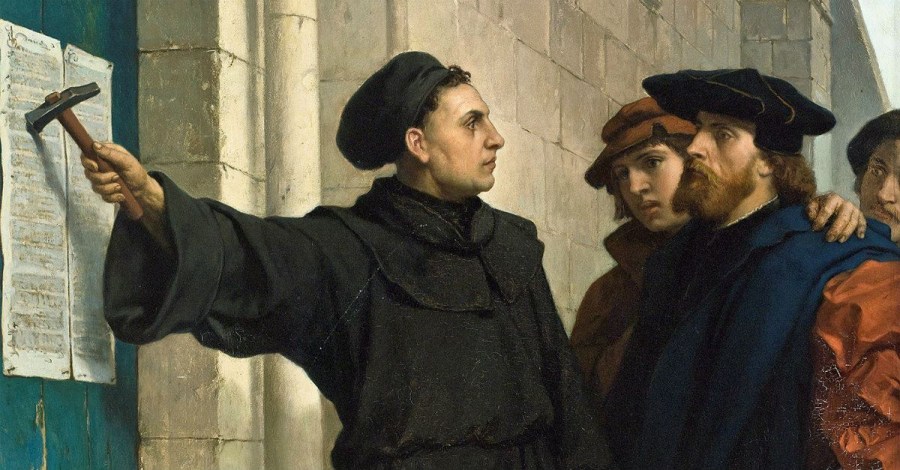
Martin Luther nails his 95 theses to the church door in Wittenberg, 31 October 1517
“The Protestant Reformation starts with a Thunderbolt.”
Martyn Lloyd-Jones
Imagine a world without Protestantism, a world where you had one of two choices—the Roman Catholic Church or paganism. This was the reality for young Augustinian Monks in the early sixteenth century. This was the world into which Martin Luther was born in 1483. By the time he died in 1546, the world was very different, with several church denominations. This was primarily due to what happened in 1517. Building upon the foundation of the pre-reformation reformers, “In that year, Luther initiated a sea change of reform that would shake the entire world.” (1).
Luther’s early years were characterised by the German word Anfcehtungen, which means “struggles.” In Luther’s case, his struggle was between a sinner and a Holy God, and there was no way that the sinner could win. Luther’s family wanted him to study law and escape the life of a peasant. On his daily walk, Luther would encounter a sculpture depicting Christ as a judge, and this image tormented Luther as he contemplated his guilt before God.
One day, as he was caught in a violent thunderstorm, he believed he was being judged, so vowing to become a monk, he withdrew from his studies and entered the monastery. As Martyn Lloyd-Jones said, “He was terrified and convicted deeply, and he never forgot it. In a sense, the Protestant Reformation starts with a thunderbolt!” Luther hurled himself into a monastic life because he believed it was the only way to relieve his internal struggles. However, it only made them worse.
“I myself was a monk for twenty years. I tortured myself with praying, fasting, keeping vigils, freezing – the cold was enough to kill me – and I inflicted upon myself such pain as I would never inflict again, even if I could. If any monk ever got to heaven by monkery, then I should have made it. If I had lasted much longer, I would have killed myself.”
Martin Luther
Despite his struggles, Luther’s intellectual gifts were recognised, and he was sent to a monastery at Wittenberg, where there was a prominent university. Luther began lecturing in theology in the hope this would help. However, after a pilgrimage to Rome, where he found the debauchery revolting, his attempts to get closer to God only served to drive him further away. As Luther studied the church father, Augustine of Hippo, he was led to the Apostle Paul and began to experience a spiritual awakening.
Luther continued to lecture on Psalms, Romans, Galatians, and Hebrews, and it is thought that he converted during that time. As he studied, he began to think differently about what it means to have a sin-nature. The word Radix (root) is used to explain that human beings are corrupt at the core, opposing the Roman Catholic idea of “demerits” (sins), “grace-enabled merits” (good works), and purgatory. Luther saw that our nature as sinners must be addressed, not just individual sins. The letter to the Romans was vital:
“For I am not ashamed of the gospel, because it is the power of God that brings salvation to everyone who believes: first to the Jew, then to the Gentile. For in the gospel the righteousness of God is revealed—a righteousness that is by faith from first to last, just as it is written: “The righteous will live by faith.””
Romans 1:16-17 NIV
“But now apart from the law the righteousness of God has been made known, to which the Law and the Prophets testify. For we maintain that a person is justified by faith apart from the works of the law.”
Romans 3:21, 28 NIV
Luther’s breakthrough came when he finally grasped that God’s righteousness wasn’t something accomplished by us but accomplished for us. He said, “There I began to understand that the righteousness of God is that by which the righteous lives by a gift of God, namely by faith…Here, I thought that I was altogether born again and had entered paradise through open gates.” To clarify this, Luther used the term alien righteousness. Luther understood that the righteousness God requires must come from outside of ourselves.
Luther’s ninety-five theses (2) were a response to the corruption of Rome, particularly a monk named Tetzel (see 35 & 36). Luther was calling for a discussion. He had no idea this would initiate a “sea change of reform that would shake the entire world.” The Roman system of penance required four steps: contrition, confession, satisfaction and absolution. With the Pope’s approval, Tetzel reduced the process to purchasing an indulgence slip, which promised the forgiveness of sins.
“Every time a coin in the coffer rings, a soul from purgatory springs.”
Johann Tetzel
Luther was horrified and could no longer keep silent. As a priest and theologian, he saw himself as having an intense responsibility to the souls of men. On 31 October 1517, Luther walked to the castle church in Wittenberg and nailed his objection onto the church door. Luther was subsequently declared a heretic by Rome and excommunicated. Asked to recant at the Diet of Worms (an assembly in Vurmz, Germany) in 1521, Luther replied, “I am bound to the scriptures I have quoted, and my conscience is captive to the Word of God. I cannot and will not retract anything since it is neither safe nor right to go against my conscience. I cannot do otherwise; here I stand. May God help me, Amen.”
Luther’s work in his latter years extended across Europe and influenced the young John Calvin, to name but a few. In 1546, Luther journeyed to Eisleben, his place of birth and fell ill, dying on 18 February 1546. His last documented words were, “I thank you, God and Father, of our Lord Jesus Christ, that you have revealed your dear Son to me, in whom I have believed, and whom I have preached, confessed and trusted.”
“We are beggars. This is true.”
Martin Luther
We live in a different world from the one Martin Luther understood, but as much as it may be dissimilar, it is also the same. Upon reading Luther’s book The Babylonian Captivity of the Church, Johannes Bugenhagen said of Luther,” The whole world is blind and in great darkness; only this man sees the truth.” Apart from the Word of God, we are in darkness. This is as significant for us as it was in Luther’s day.
The questions are still the same: What will happen to me in death? How can I know if God loves me? Is salvation a gift? Am I good enough for heaven? At the beginning of the sixteenth century, Europe had been without a Bible that people could read for a thousand years, and it is due to the Reformation that we are not in such a position today.
Nevertheless, Rome has not changed; many today believe in salvation through works. In Luther’s day, the priest would tell the people, “God will not deny grace to those who do their best.” Does that sound familiar?
As Michael Reeves observes, “Almost certainly, what confuses people into thinking that the Reformation is a bit of history we can move beyond is the idea that it was just a reaction to some problem of the day. But the closer one looks, the clearer it becomes: the Reformation was not principally a negative movement about moving away from Rome and its corruption; it was a positive movement about moving toward the gospel. And that is precisely what preserves the validity of the Reformation for today.” (3).
We live in a time of anti-theology. Many seem unable to discern false teaching. As Christendom is observed today, the words of the Apostle Paul in 2 Timothy 4:3 are apropos, “For the time will come when people will not put up with sound doctrine. Instead, to suit their own desires, they will gather around them a great number of teachers to say what their itching ears want to hear.”
Like the Roman church of Luther’s day, some are peddling Christianity to make a profit. This is seen in the “prosperity gospel” and “health-and-wealth” preachers, who offer blessings in exchange for donations. Is this any different from Tetzel? (see 1 Tim 6:5). We are dealing with theological illiteracy and a generation indoctrinated by the quasi-religious positive-thinking and self-esteem movement.
Considering our context, we understand that the church must be “reformed and always reforming.” By that, we do not mean we change the message to make Christianity more discernible and relevant today, but we turn to the Word of God to allow it to reform us. The Reformation rediscovered the gospel, which must continuously be rediscovered.
Michael Reeves observes, “Both the needs and the opportunities are as great as they were five hundred years ago—in fact, they are greater. Let us then take courage from the faithfulness of the Reformers and hold the same wonderful gospel high, for it has lost none of its glory or its power to dispel our darkness.” (4).
We are beggars.
This is true of every generation, which is why Luther still matters.
“When the devil throws our sins up to us and declares that we deserve death and hell, we ought to speak thus: “I admit that I deserve death and hell. What of it? Does this mean that I shall be sentenced to eternal damnation? By no means. For I know One who suffered and made satisfaction on my behalf. His name is Jesus Christ, the Son of God. Where he is, there I shall be also.”
Martin Luther
Notes
- Stephen J. Nichols – Martin Luther, A Guided Tour of his Life and Thought, P&R Publishing, 2002, p14
- https://tabletalkmagazine.com/article/2017/10/ninety-five-theses/ (accessed 24/10/22)
- https://tabletalkmagazine.com/article/2017/10/reformation-still-matters/ (accessed 25/10/22)
- Ibid (accessed 25/10/22)
Scripture quotations are from the NIV

 seekingthekingdom.blog
Good one!! 👌🏽A nice bit of history, I like it 😆
LikeLiked by 1 person
Thank you hehe 🙃
LikeLiked by 1 person
Thank you for your blog x
Andrea ________________________________
LikeLike
Thank you Andrea 😃
LikeLike