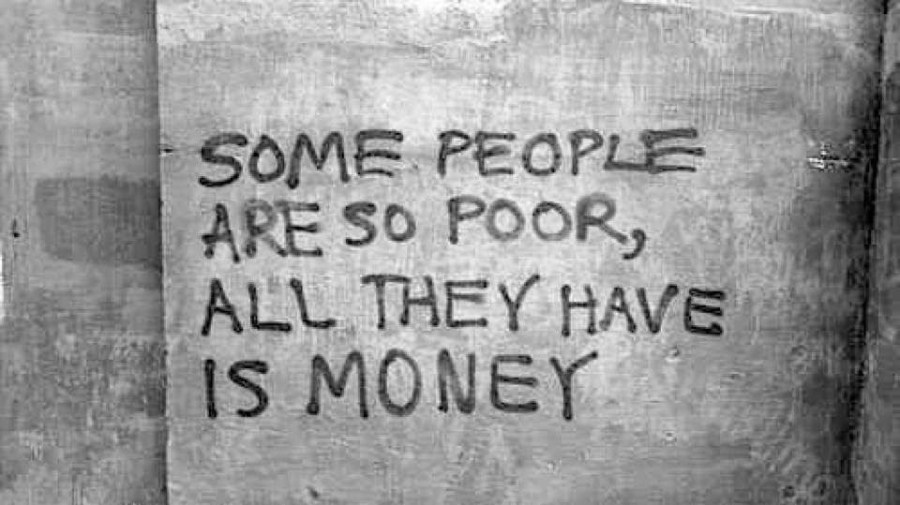
“And he said to them, “Take care, and be on your guard against all covetousness, for one’s life does not consist in the abundance of his possessions.””
Luke 12:15 ESV
Have you ever been in the middle of saying something significant when you were rudely interrupted by somebody who suddenly mentioned something completely off-topic? It can be very frustrating!
On this occasion, we find Jesus teaching critical spiritual truths to thousands of people (see 12:1-12). What a crowd this was! What an opportunity for Jesus. Suddenly, during this rich spiritual teaching, a man shouted, “Teacher, tell my brother to divide the inheritance with me” (see 12:13).
I wonder how you or I would have responded? Would we have told the man to sit, be quiet and listen? However, Jesus, the master evangelist, turned this interruption into an opportunity and narrated a parable (1), which is known as the parable of the Rich Fool.
The man was in dispute with his older brother over the inheritance. There is nothing new under the sun! Assuming Jesus is a Rabbi, the man sought to invoke the help of the law (see Num 27:1-11, Deut 21:15-17). The man was more concerned with Jesus being a lawyer than a teacher! He had come to Jesus in a spirit of greed.
That was a big mistake, as the man now finds himself as the springboard to a warning against covetousness (see 12:15). Jesus had no interest in getting involved in this man’s dispute over inheritance (see 12:14). Jesus was on a mission—a mission to save souls, not to be a judge in worldly disputes (see 19:10).
So, Jesus tells a parable about the fallacy of greed. The belief is that life consists of acquiring possessions and wealth (see 12:15).
The Rich Man
“And he told them a parable, saying, “The land of a rich man produced plentifully, and he thought to himself, ‘What shall I do, for I have nowhere to store my crops?’ And he said, ‘I will do this: I will tear down my barns and build larger ones, and there I will store all my grain and my goods.”
Luke 12:16-18 ESV
At first glance, it may seem that there is nothing wrong with what this man is doing. After all, isn’t this a sensible business strategy? The man is a wealthy landowner whose land has had a bumper crop! What is the logical thing to do? Expansion! It’s a very contemporary idea, after all. We see businessmen and women doing the very same thing today.
The Bible does not condemn success or wealth. God never condemned Abraham, Solomon, Job or Joseph of Arimathea for being wealthy (see Gen 13:2, 1 Kings 3:10-13, Job 42:12, Matt 27:57). So, what is the difference with this man?
A closer look gives us hints about the man’s heart. Notice how he constantly refers to himself in the first person singular (2). The man is wholly self-centred and egocentric. There is no evidence that the man acknowledges God for his success. After all, isn’t it God who provides all those necessary things in nature for crops to grow? (see Prov 3:9-10).
There is no indication that he cares for the poor or desires to share with those in need (see 12:18). He has not honoured God with his wealth and produce. The man loves money, not God (see Matt 6:24, 1 Tim 6:10).
The man was greedy and lived without reference to the God who had given him his wealth. The man is living as the quintessential secular atheist, consumed with ease, pleasure and security. Remember that this parable is not about wealth, but greed is essential. We may not all be wealthy, but we can all be greedy. Jesus wants us to see all our faces in the parables photograph and ask the question:
What about me? (see 12:21).
“He demonstrated un utter disregard for the basic summary of God’s law: “Love the Lord Your God with all your heart, with all your soul and with all your mind. And love your neighbour as yourself.” God and neighbour did not exsist for him. He only thought about himself.”
Simon J.Kistemaker
The Fatal Mistake
“And I will say to my soul, “Soul, you have ample goods laid up for many years; relax, eat, drink, be merry.”’”
Luke 12:19 ESV
Around the turn of the 3rd century BC, a group known as the Cyrenaics became active. They taught that the pleasure of the moment is the criterion of goodness. To achieve happiness, human beings must maximise pleasure and minimise pain. This philosophy was refined by the Epicureans, who debated the Apostle Paul in Athens (see Acts 17:16-34).
The mantra of this philosophy is well-practised today! “Relax, eat, drink, be merry.” So, when Jesus said this, he was purposeful in His language. Paul used a similar phrase when he wrote to the Corinthians. He said, “If the dead are not raised, “Let us eat and drink for tomorrow we die.”” (see 1 Cor 15:32).
“Here is the secular mindset and lifestyle, based on the assumption that this is the only life and that it is one-dimensional.”
Douglas J. W. Milne
This is how vast numbers of people are living their lives in the world today. Along with aggressive consumerism and hedonistic philosophy, men and women live the same way as the man in the parable. Greedy and self-indulgent, they see life as one-dimensional. They have a “here and now” mentality. They live to acquire possessions and wealth, accumulating treasures on earth to enjoy in the present and rely on in old age.
So, when Jesus tells us, “One’s life does not consist in the abundance of his possessions” (see 12:15), we need to grasp how radically counter-cultural this is. True life, says Jesus, is to be found not by investing in the bank of this world, which gives little return, but by investing in the bank of heaven, whose return far outways our ability to comprehend (see 1 Cor 2:9). The man in the parable may have had earthly wealth. Still, he had zero in his spiritual account. This was the fatal mistake that people are repeating today.
What bank are you investing your life in? (see Mat 6:19-21).
The Important Lesson
“But God said to him, ‘Fool! This night your soul is required of you, and the things you have prepared, whose will they be?’ So is the one who lays up treasure for himself and is not rich toward God.””
Luke 12:20-21 ESV
Get ready for the punchline!
This simple but profound parable has been building up to this significant point. God was about to close the man’s account. What would the verdict be? In Greek, the word translated required means “to ask for something to be returned.”
Jesus tells us that life is not one-dimensional. Our lives are on loan; one day, we must account for how we have lived. Can you see the irony? The man had lived for the possessions he owned, but the reality was he didn’t even own his life! (see Psalm 24:1). The man failed to reckon with God, denying life’s accountability and finality.
The man failed to grasp that the day is coming when we must die and surrender all we own to those who come after us (see 12:20, Eccl 2:18-19). That day may come sooner than we think! (see James 4:13-14, Eccl 9:12, Ps 39:5). The man failed to value his eternal soul above his earthly possessions, and people do the same today.
“You may control your investments, but you don’t control your lifespan.”
Alistair Begg
Earlier on in the gospel of Luke, Jesus had told His listeners, “For whoever would save his life will lose it, but whoever loses his life for my sake will save it. For what does it profit a man if he gains the whole world and loses or forfeits himself?” (see 9:24-25). This parable is a powerful reinforcement of that great juxtaposition. The man, whilst on earth, did not think about sharing his wealth, but in his death, that is exactly what happens (see 12:20). By holding tightly onto his life, the man loses it. We save our lives only by losing our lives for Jesus’ sake and the gospel’s sake.
What is God’s verdict? The man is a fool! (see 12:20). When the bible uses the word fool to describe a person, it does not discuss intellectual capacity. It refers to someone who lives while ignoring God’s claims on their life. The same is true for every person who lives like this man and is not rich towards God (see 12:21).
What is the application? How can I be rich towards God? That is the great question the parable leaves us asking. Being rich towards God is the opposite of laying up treasure for ourselves. It means acknowledging God as the source of all the good we enjoy and being willing to use our lives and possessions for His glory rather than for our selfish desires.
The problem is that, by nature, we are rich toward ourselves, not God. The answer paradoxically is in becoming poor in spirit (see Matt 5:3). In God’s economy, down is the way up! (3). First of all, we must recognise that we owe God a debt we cannot pay back (see Rom 3:23). We need to open a spiritual account! We must become rich in faith and good works (see James 2:5, 1 Tim 6:18-19).
Only by recognising this and submitting in repentance and faith to the rule and reign of God’s appointed King Jesus can we begin to add to our spiritual account and lay up for ourselves treasures in heaven. Eternal life is found in the abundance of knowing God (see John 17:3). It is only by trusting in Jesus who went to the cross as a perfect sacrifice for sins and by his work “cancelled the record of debt that stood against us” that we can know eternal life (see Col 2:14). Have you found God to be your treasure? “For where your treasure is, there your heart will be also.” (see Matt 6:21).
Miguel Nunez writes, “This parable is short and simple, but at the same time, it is rich and profound. After the fall, the descendants of Adam acquired a self-centred, earthbound, and “here and now” worldview. Jesus came to save what was lost and to restore a God-centered, God-glorifying, and joy-filled life. Embracing this is to be our priority” (4).
Is it yours?
Notes
- For a brief explanation of parables see – https://theedgedoctor.wordpress.com/2021/07/17/lessons-from-the-parables-a-condition-of-entry/
- A similar attitude is found in The Parable of the Pharisee and the Tax Collector (Luke 18:11-12)
- In the Sermon on the Mount Jesus describes the characteristics of the person who is rich towards God (Matt 5-7)
- Miguel Nunez, The Parable of the Rich Fool, TableTalk Magazine, Ligonier Ministries, February, 2020, p7
All scripture quotations are from the ESV


Absolutely brilliant. I really enjoyed reading it to be honest. Praise God for His word of truth 🙏😊
LikeLiked by 1 person
Thank you so much Jenny ☺️
LikeLike
Eat drink and be Merry – there is nothing new under the sun!
Thanks for this. Good point about opening a spiritual account. Something we should all be much more concerned with.
LikeLiked by 1 person
Thank you Liz 😊
LikeLike