Encounters with Jesus
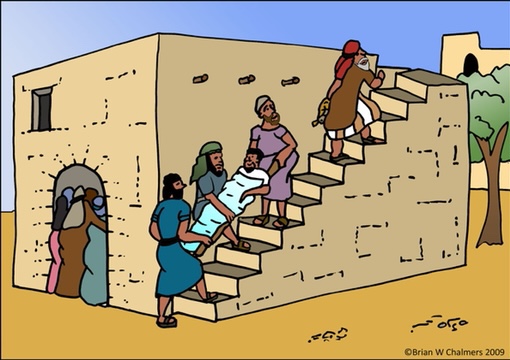
“And when he returned to Capernaum after some days, it was reported that he was at home. And many were gathered together, so that there was no more room, not even at the door. And he was preaching the word to them. And they came, bringing to him a paralytic carried by four men. And when they could not get near him because of the crowd, they removed the roof above him, and when they had made an opening, they let down the bed on which the paralytic lay. And when Jesus saw their faith, he said to the paralytic, “Son, your sins are forgiven.” Now some of the scribes were sitting there, questioning in their hearts, “Why does this man speak like that? He is blaspheming! Who can forgive sins but God alone?” And immediately Jesus, perceiving in his spirit that they thus questioned within themselves, said to them, “Why do you question these things in your hearts? Which is easier, to say to the paralytic, ‘Your sins are forgiven,’ or to say, ‘Rise, take up your bed and walk’? But that you may know that the Son of Man has authority on earth to forgive sins” —he said to the paralytic— “I say to you, rise, pick up your bed, and go home.” And he rose and immediately picked up his bed and went out before them all, so that they were all amazed and glorified God, saying, “We never saw anything like this!””
Mark 2:1-12 ESV
Identity
In our world, it is possible to be the focus of public attention yet unidentified. One of the major themes of Mark’s gospel, or “good news”, is the theme of identity. This theme keeps reappearing during the gospel (1:24, 27, 34, 2:6, 4:41, 6:2, 8:27, 11:28, 15:2). Identity is the book’s central question, and it appears in different ways. In one sense, it is written in such a way that it prompts the reader to ask, ‘Who is this man?’
Mark does not want his readers to miss who Jesus is. Mark himself is so convinced about the identity of Jesus that he lets it slip in the very first verse! (1:1). As you read the gospel, it appears to be driving us relentlessly towards Peter’s great confession of Jesus Christ, the Son of God (8:27-30). Mark wants us to come to the same conclusion as he does.
A man with a great Need (2:1-4)
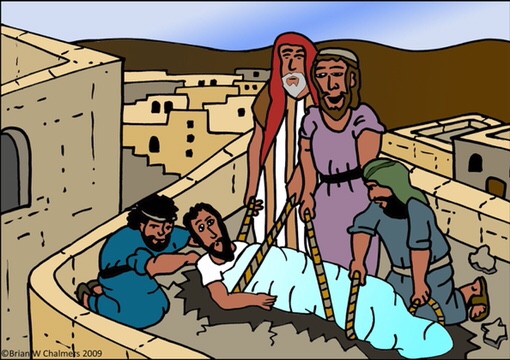
The paralytic’s friends use their initiative to get into the house.
After preaching in various synagogues throughout Galilee (1:39), Jesus returns home to Capernaum. His fame had spread so much that the house had no room to hear him speak. There was even a queue at the door!
As they listened to Jesus, He got a drop-in visitor, literally! In the time of Jesus, roofs would have been flat, constructed of thatch. On top of the thatch would be hard-packed mud. Four men, carrying a paralysed man were so determined to see Jesus that not getting through the door was no problem. Why worry when you can break through the roof! I wonder what the owner of the house thought about it!
Convinced that He could heal their friend, they lowered him right before Jesus. Imagine the scene. All eyes are now fixed on Jesus. What would He say and do next? What Jesus said next was probably the last thing on people’s minds.
A man with a greater Need (2:5)
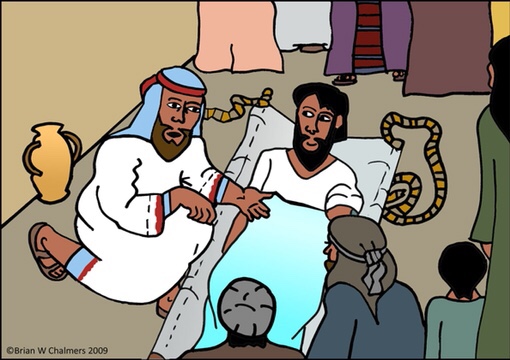
Jesus gets a drop-in visitor.
There is nothing to suggest that the paralysed man was looking for forgiveness. He had probably heard that Jesus had healed many people (1:34), and he had come to be healed.
Jesus was not indifferent to this man’s plight. Perhaps, if it were us, our first response would have been to ask for some money to fix the roof! Jesus, however, speaks to the man with tender compassion. More important than physical healing, Jesus first deals with what was the man’s (and ours) greatest need: the need for forgiveness, cleansing from sin, and a restored relationship with God.
This was a need so much greater than he had come for. Jesus took this opportunity to focus the crowd on the excellent issue for which He had come. Not primarily to deal with the physical but the spiritual (1:14-15).
When Jesus said, “Son, your sins are forgiven,” He was pointing to a much bigger problem than legs that didn’t work. He was pointing to the problem of our alienation from God, captivity to sin, and inability to please God (see Eph 2:13, Eph 4:18, Rom 3:23, Rom 8:5-8).
This story uses a metaphor for what people incorrectly see as their greatest need. People go to church because they think a ‘little religion’ will make them feel better. They get involved with charitable work. They try to do ‘good.’ Others resort to hedonism, or think that a new job, the perfect partner, a new house, a new car, or more money will satisfy them, but it never works. As one writer put it,
“Because you (God) have made us for yourself, and our hearts are restless until they find their rest in you” (1)
By nature, we reverse the teaching of Jesus and put the great need above the greater need. We fail to recognise that forgiveness of sins is our greatest need. The Bible is devastating in its diagnosis of the human condition. It tells us we fail to recognise these things because we are spiritually blind. Sin is a condition before it is an action (see 1 Cor 2:14, 2 Cor 4:3-4, Matt 13:13, Rom 1:18, John 3:19).
Not only do we reverse Jesus’ teaching on a personal level, but we do it on a national level. Society tries to fix its problems through better education, scientific and medical advancement, social engineering, legislation, medication, and politics, but it never works. Humanity is on a carousel horse, forever moving in a circle but never getting anywhere.
Recently, in London, a woman was tragically kidnapped and murdered. This sparked a national debate about violence against women. I watched an interview with a Member of Parliament. The interviewer asked the MP what could be done. The first thing the MP said was more education. Education is good, but it cannot solve the human problem because it is a moral problem, not an intellectual one. These are ideas from a world that has run out of ideas.
Contrary to our world’s philosophy, man is not morally neutral. The Bible says we have a heart problem. Have you ever played Lawn Bowls? They are designed to travel a curved path because of a weight bias. The Bible says our hearts are just like that. We are biased towards evil (see Jer 17:9, Matt 15:19). This does not mean that we are as bad as we could be, but it does mean that every facet of the human psyche is corrupted by sin. No amount of ‘good’ we try to do can outweigh the bad (see Is 64:6, Rom 3:12).
No self-help books or motivational talks will solve our sin problem. By nature, we do not have an answer to the lack of peace, evil, guilt and pain in our hearts. Like the paralysed man, we are unable to heal ourselves and get up and walk. Modern man wants us to look within, but the answer must come from outside ourselves. As one writer put it,
“The problems are: what is life; how can man live in a decent manner; how can a man control himself and his baser instincts and desires; how can a man live as a man; how can he so live that even if he is stricken down by an illness, or shattered by an accident and loses everything on which he has depended, he is still alright; how can a man sing in prison? These are the questions. How can a man die? These have always been the questions, they are still the same; there are no new problems.” (2)
It is only by looking away from ourselves to Him, who is outside of us, to Him who has the power to reach out to us and say, “Son, your sins are forgiven.” That we can begin to understand these great questions.
Turning the Tables (2:6-9)
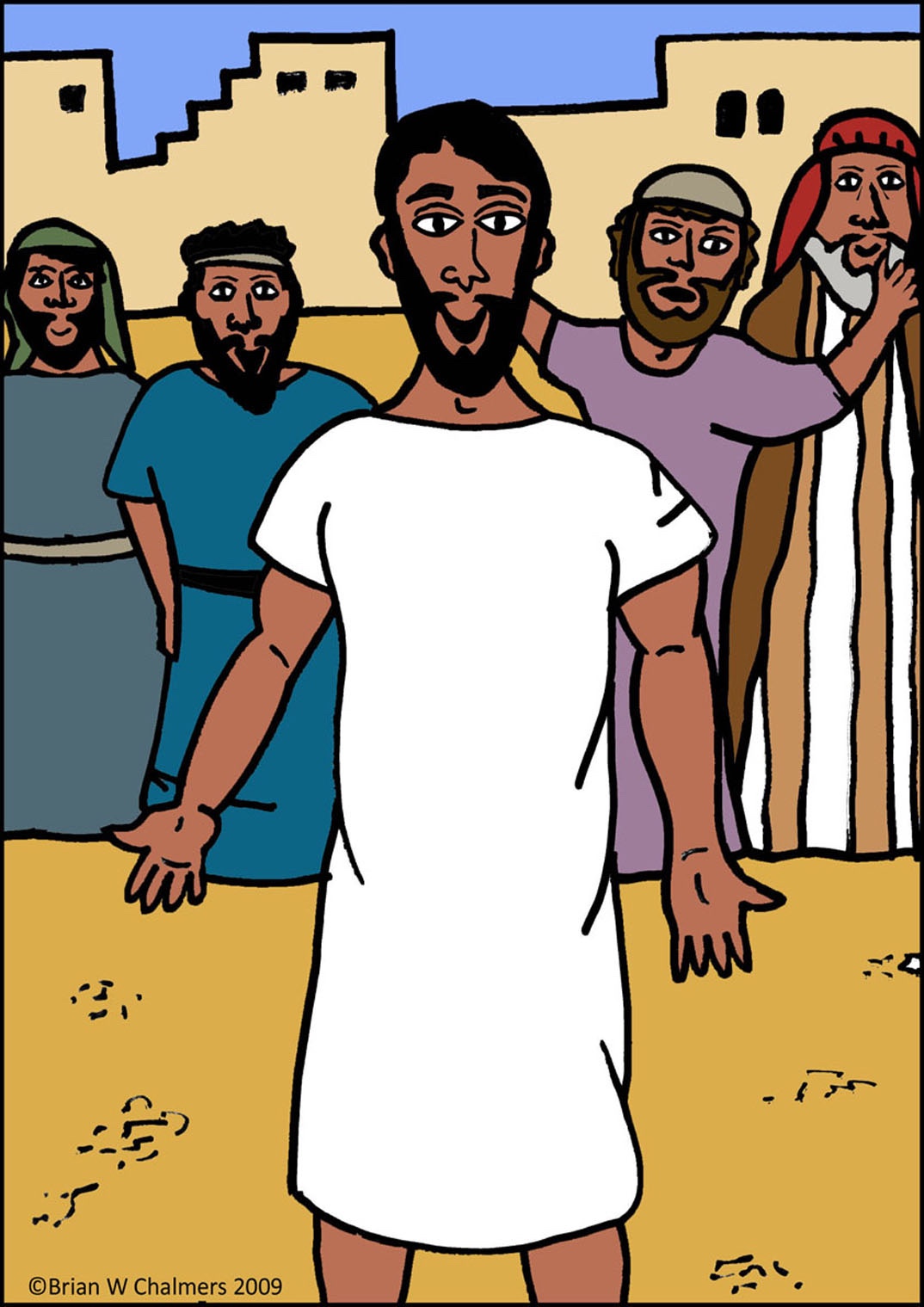
Not only is the man healed, but he receives the forgiveness of sins.
What Jesus said did not escape the religious elite (2:6-7). The Scribes realised that by saying what he said, Jesus was acting as though He had the authority of God. The theology of the Scribes was correct, but their conclusion was wrong. As one writer puts it,
“There was nothing wrong with their theology. But there was something wrong in their logic. They reasoned: since only God can forgive sins, and this man claims to forgive sins, then he must be blaspheming. There was, however, an alternative conclusion: perhaps he did have the authority to forgive sins, in which case be must be God! But that was impossible” (3)
When Jesus encountered these men, he often came from a perceived disadvantage to gain an advantage. Jesus did this a lot, and it made them furious! Jesus does the same thing by presenting them with a challenge (2:8-9).
Is it easier to say, ‘Your sins are forgiven?’ or ‘Get up and walk?’ It is, of course, easier to say, ‘Your sins are forgiven?’ Why? It is a statement that cannot be immediately verified, whereas speaking to someone who is paralysed, ‘Get up and walk’ can be. He either walks or he doesn’t walk!
The Messiah Revealed (2:10-12)

“These are written so that you may believe that Jesus is the Christ, the Son of God, and that by believing you may have life in his name.”
John 20:31 ESV
So, to prove His identity as the one who can forgive sins, Jesus goes on to say the difficult thing, ‘Get up and walk.’ To everyone’s amazement, the paralysed man got up and walked. The tables had been turned! There was now only one conclusion to make: If Jesus could heal this man, then surely he could forgive his sins, too. Jesus, as the ‘Son of man’ (a divine designation), had the authority to forgive sins (see Dan 7:13-14).
In reality, the forgiveness of sins didn’t come easily. It may have been easier to say, but it certainly wasn’t easier to do (15:1-41). At the time, nobody understood that Jesus had this authority because He had come to sacrifice Himself and to die on the cross to make forgiveness possible (see 1 Pet 3:18, Is 53:1-12, Gal 3:13, Gal 1:4, Rom 5:6-8).
The healing of the paralysed man is a beautiful picture of the restored sinner. By looking to Jesus in faith and trusting in His Word, we can be free from the crippling effects of sin and able to walk in the newness of life. This is the heart of the gospel: so that we could be forgiven; God did not spare his own Son but delivered Him up for us all (see Rom 6:4, 8:32).
‘The degree to which you see your own need of that forgiveness is the measure of how clearly you understand the gospel.’ (4)
Nobody who has an encounter with Jesus will ever be the same again.
Notes
- Augustine, Confessions, Chapter 1
- D. Martyn Lloyd Jones
- Sinclair B Ferguson, Let’s Study Mark, Banner of Truth, 2011, p26
- Ibid, p27
Pictures – Brian W Chalmers – ebibleteacher.com
All scripture quotations are from the ESV


Brilliant Rob as always. 🙏😊
LikeLiked by 1 person
Thank you Jenny 🙃
LikeLike