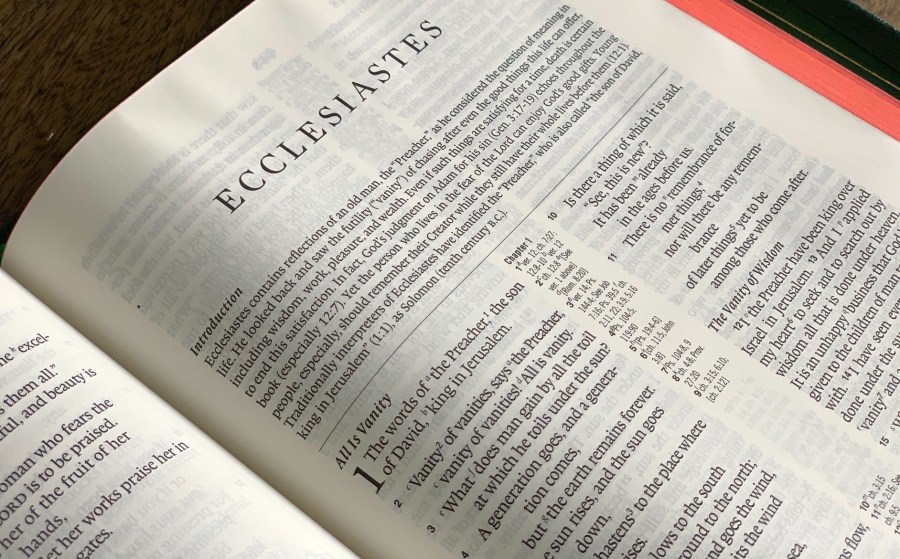
“The words of the Preacher, the son of David, king in Jerusalem. Vanity of vanities, says the Preacher, vanity of vanities! All is vanity.”
Ecclesiastes 1:1-2 ESV
The book of Ecclesiastes forms part of the Bible’s wisdom literature. A significant theme of wisdom literature is how to live wisely in God’s world. It was written by one who identifies as Qohelet, usually translated into English as a preacher or teacher. Ecclesiastes has been an enigma to many, but a correct understanding of the book is to find a treasure chest of biblical wisdom.
Vanity of vanities
The word ‘Hebel’ is translated as ‘Vanity’ or ‘Meaningless’ depending on the translation. The word conveys the perplexity and the frustration of life. This is articulated right at the beginning of the book in (1:2). The phrase, ‘striving after the wind’ or ‘chasing after the wind’ again, depending upon translation, is seen numerous times in the book and again conveys the idea of frustration and perplexity. Have you ever extinguished a candle with your fingers and then tried to catch the puff of smoke? It’s impossible to hold onto. It’s there for a split second, but it’s gone. It’s slipped through your fingers. That’s the idea Ecclesiastes wants us to take up. ‘Hebel’ could also be translated as ‘smoke’ or ‘breath’ (see Ps 39:5-6, 11, James 4:14).
Under the sun
So why is life frustrating and perplexing? ‘Under the sun’ (1:3,14) is another phrase used in the book. Some commentators believe that when this phrase is used, the writer is reverting to a non-Christian way of thinking. So the writer is saying, ‘This is what life is like for the unbeliever’, but it seems more likely that when the writer uses the phrase ‘under the sun,’ he is referring to life in a fallen world, which we all – Christian and non-christian alike live in.
Christians have different worldviews, which affect their thinking and give them answers to many questions, but they do not suddenly become immune to the perplexities of life. Neither do they have all the answers to every mystery. You could say that Ecclesiastes is the bible’s commentary on the fall of man, as described in Genesis chapter 3. The representative of humanity, Adam, fell into sin, and now God has cursed this world because we have all sinned (see Rom 5:12). This is the result. This world is now a very perplexing, frustrating and mysterious place to live in. All the things our culture idolises bring no lasting satisfaction. Ecclesiastes explores the pursuit of education, pleasure, work and possessions and comes up with a sobering conclusion (2:11).
This does not mean that these things are evil or have no merits, but that those things in and of themselves provide no real answers to the meaning of life and no lasting satisfaction. Life does not necessarily go how we would have hoped it would. The things we put all our efforts into leave us scratching our heads. Perhaps a pandemic comes along to upset all our plans, or a tragedy comes along and strikes, and our world is never quite the same again.
In 2014, a friend of mine was driving in her car on the way to do some shopping. She was involved in a collision and died instantly. She was a Christian aged 37, married with two small children. There are things to which there are no immediate answers. Job’s friends thought they were wise, but in the end, they were found to be miserable comforters (see Job 16:2). The world is going through a time of testing. Coronavirus has impacted all of our lives in varying degrees and ways. As we continue to navigate Coronavirus, here are six reminders from Ecclesiastes.
1. There is nothing new – Ecclesiastes 1:9-11
The restrictions we have experienced in the past year due to Coronavirus are new for many of us, and many people have not experienced anything like it. However, there is nothing new about pandemics or how we deal with them. Martin Luther, the great reformer speaking in a time of plague in 1527, wrote,
“Therefore I shall ask God mercifully to protect us. Then I shall fumigate, help purify the air, administer medicine, and take it. I shall avoid places and persons where my presence is not needed in order not to become contaminated and thus perchance infect and pollute others, and so cause their death as a result of my negligence…”
Pandemics are not a new phenomenon. Governments understand this, which is why they have departments that prepare for them (some better than others). As Ecclesiastes says, ‘There is nothing new under the sun.’ We are not to be taken by surprise.
2. Death comes to all people – Ecclesiastes 7:1-2
This is the sucker punch that Ecclesiastes keeps hitting us with throughout the book, and it is purposeful. We live in a world of repetitive cycles. We see that in the poetry of chapter 1. This repetitive cycle is true for generations of humans. We are just one of many generations; here for a short time before the next. This repetitive cycle is God’s order. Ecclesiastes wants us to accept our place in this cycle. We will all die. Some, like my friend, will die in a tragic accident. Others will die of an illness, perhaps Coronavirus or something else. Indeed, through this pandemic, God is reminding us of the reality of death.
Death can come to us without warning (9:11-12). Perhaps by the grace of God, we will reach and die of old age. The point is it doesn’t matter how we die; what matters is we ALL DIE! Ecclesiastes wants us to accept this reality, not fight against it, and in accepting the reality of death, we are to find life-changing freedom as we realise that the gifts God gives us in life are to be enjoyed. They are not ends in themselves to spend our lives striving for. We are to seek to know the God of the gifts, not the gifts of God. Ecclesiastes wants us to live our lives in light of our deaths, and by doing so, we will find the path of wisdom.
3. We are to remember our Creator in the days of our youth – Ecclesiastes 12:1
Most older people acknowledge that life appears to fly by so quickly. As the author Terry Pratchett put it,
“Inside every old person is a young person wondering what happened”.
Why the emphasis on youth? It is not only because life passes so quickly. It is also because time is often not very kind to people. Time usually hardens hearts. Isn’t this our experience? Young people are rarely cynical, but isn’t it fair to say that older people are seldom not cynical? A lifetime of sin is not easily escaped. (8:8). There is an inescapable truth that sin hardens hearts. The longer a person lives in sin, the harder it appears for them to consider the truths of the gospel until it gets to a point where it seems nothing can move them at all! Thank God that all things are possible with Him! (see Matt 19:26). The Bible tells us that a day of reckoning is coming – a judgment where we will give an account of our lives. (12:14, Heb 9:27). We are not to delay in responding to the call of God because to do so is to reject His call. That is why the Bible consistently calls us to respond to the call of God today (see Heb 3:15).
4. We are to know joy amid our circumstances – Ecclesiastes 2:26, 3:12-13
You may be thinking all this is pretty negative, but the writer of Ecclesiastes is not a fatalist. Joy is mentioned several times, even to the extent that the writer has been called a preacher of joy. Perhaps that is taking it a bit far. However, Ecclesiastes commends the enjoyment of life. Life in this world is an enigma. Joy and sadness seem to be able to co-exist. This is how life is in a once-perfect world ruined by sin and sinners. Ecclesiastes calls us to find joy in God’s simple but profound gifts. A good meal, a friendship, a marriage, a walk in beautiful surroundings. All of these things, taken for granted and treated as ordinary, are, when viewed correctly, extraordinary and profound gifts to us from our creator. Joy in lockdown? Yes, because for the Christian, Joy is not dependent on circumstances. Joy is a fruit of the Spirit (see Gal 5:22-23).
5. We are to fear God and keep His commandments – Ecclesiastes 12:13
A profoundly unpopular idea today, but not to fear God, is finding oneself in the most perilous positions. The Christian understanding of the fear of God is not one of terror but the proper sense of who God is and who we are in the light of who God is (see Luke 12:4-5). It is a fear which drives us to God for His mercy. A person who fears God in this way must abandon self-glory and submit entirely to God and His word. This is why a genuine fear of God seems so very rare in our self-obsessed, narcissistic generation.
But how do we fear God and keep His commandments? This is where we need to open the rest of the bible. We have previously noted the repetitive cycle of the universe, but this cycle is also true of sin. Sin is disobedience to the law of God, and the Bible tells us that we have all sinned (see Rom 3:23). Human beings have always been stuck in this cycle of sin, which we cannot escape. There is nothing human beings can do to satisfy God’s holiness. This has been true and continues to be true from the beginning. There is nothing new (1:10).
Perhaps Ecclesiastes is pointing us somewhere else? Don’t we long for something new? Don’t we end our week at work by saying to ourselves, ‘Is this it? Is this all there is to life?’ Don’t we long to eliminate this cycle of sin, failure and death? Could there be a human being who has done something new? The Bible says yes! Jesus did what no other human being could do. Being the sinless Son of God, He could fear God and keep His commandments perfectly. Only Jesus can rescue us from the cycle of sin, failure and death by becoming our substitute and dying for us on the cross so that we might be forgiven and reconciled to God.
The New Testament does not quote Ecclesiastes directly but certainly alludes to it. Paul writes about the groaning and pain being endured by creation and those trusting in Jesus (see Rom 8:18-23, 2 Cor 5:1-5). What is significant is that Paul speaks within the context of giving the Holy Spirit to believers. It is by the power of the Holy Spirit that brings new life to the heart amid sin. By the power of the Holy Spirit, we are set free from the dominion of sin and can live in the newness of life (see Rom 6:14). Only by the power of the Holy Spirit can we fear God and keep His commandments.
6. Remember there is a judgment to come – Ecclesiastes 12:14
The words in chapter 12 are meant to make us sit up and listen (12:11), and They are sharp but loving words. The point of Ecclesiastes is to prepare us for the judgment of God because it’s coming. Ecclesiastes points us to a day that many people are not ready for. For many in this world, life revolves around ‘living your best life now.’ If this life is all we are interested in, we will not go to heaven. The wonderful message of the Bible is that all this can change. You can be ready for Judgment by believing in all that Jesus has done, turning from your sin and self and following Jesus. By doing that, you will know about life. Ecclesiastes tells us that there is very little to gain by toiling under the sun, but the apostle Paul tells us,
“For to me to live is Christ, and to die is gain.”
Phil 1:21 ESV
Are you living wisely in God’s world?

 seekingthekingdom.blog
Thanks for this. Remember thy creator in the days of thy youth, was a favourite verse of my pastor’s wife and one I have tried to keep in mind while doing youth work.
LikeLiked by 1 person
Thank you so much Liz
LikeLike
Amazing writing ✍ brother. Pure truth. I pray for our Lord to keep on using you for His purpose 🙏
LikeLiked by 1 person
Thank you Jenny 😊
LikeLike