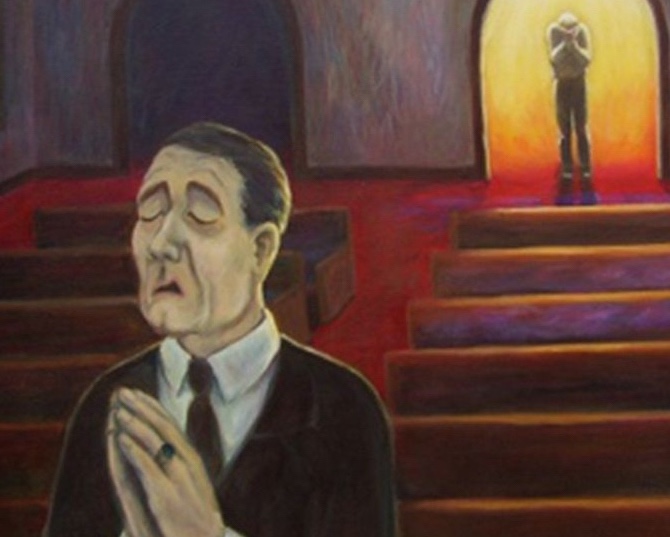
“He also told this parable to some who trusted in themselves that they were righteous, and treated others with contempt:”
Luke 18:9 ESV
On the surface, it is a story about two men and their prayers, which might lead one to think that it is essentially about prayer. Actually, it is a parable of salvation.
James Montogomery Boice
True Versus False Spirituality
Spirituality has become a kind of buzzword in today’s culture.
The problem is that many people don’t understand what they mean and cannot define spirituality.
There is no doubt that the modern concept of spirituality has little to do with ideas of sin and forgiveness. In our ‘generation me’ culture, spirituality is usually defined as seeking self-healing and self-knowledge and promoting certain ethical ideals and virtues.
In this crucial parable (1), Jesus challenges the false spirituality of His day and, in doing so, gives us a pitfall to avoid and a pattern to follow.
The target audience of this parable was anybody who trusted in their righteousness and treated others with contempt (18:9). In other words, people who thought they were fine doing it by themselves. Jesus was surrounded by people who were convinced of their righteousness and were subsequently blind to their need for forgiveness.
A Mirror
Just like a mirror that reflects what we look like on the outside. God’s Word reflects what we are like on the inside (see James 1:23-24, Heb 4:12).
Surveying our world today reveals that not much has changed. As you read this parable, perhaps you will see this pharisaical spirit in your heart, for haven’t we all looked down on others while boasting in our virtues?
The theologian and pastor R.C. Sproul tells a story about when he was engaged in evangelism in 1969. He would use diagnostic questions to begin conversations about the gospel. Thousands of people answered these questions. One question was, “Suppose you were to die tonight and stand before God, and God asked, ‘Why should I let you into My heaven?’ What would you say?” After analysing the answers, R.C. Sproul estimated that 90% of the people who answered trusted in their righteousness to get them into heaven (2). A similar survey carried out today would reveal the same.
What would your answer be? Perhaps after reading this story, you will be surprised. After all, every good story has a surprising twist, and this one is no exception.
A Shocking Contrast
““Two men went up into the temple to pray, one a Pharisee and the other a tax collector.”
Luke 18:10 ESV
“If the Pharisee was the model citizen, the Tax Collector was the criminal avoiding arrest.”
David McLemore
This parable reveals how true righteousness is obtained.
By contrasting the way of salvation with a faulty view, we find the answer to the great question, “How can a man be in the right before God? How can he who is born of woman be pure?” (see Job 25:4).
In this parable, we have men of two extremes. One man represents the pinnacle of religion, and the other man represents the depravity of humanity. Which one will go to heaven? The religious one, of course!
Are you certain?
The Coming Kingdom
In Luke’s gospel, we read that Jesus had been engaging with the religious Pharisees, who were shocked about who Jesus was mixing with. Chapter 15 tells us, “Now the tax collectors and sinners were all gathering around to hear Jesus. But the Pharisees and the teachers of the law muttered, “This man welcomes sinners and eats with them.”” (15:12).
As far as the Pharisees were concerned, if Jesus were a religious man, he would mix with spiritual people. He wouldn’t be fraternising with sinners, prostitutes, tax collectors and the marginalised in society. How could Jesus have combined with such people if he was from God? How the Pharisees misunderstood that Jesus had come to seek and save the lost (19:10).
Jesus tells the Pharisees that the Kingdom of God would not come in a way that could be observed (17:20-21). In other words, the Kingdom of God would come unexpectedly. The Jews were waiting for a political Kingdom which would defeat the occupying Romans and establish the nation of Israel.
However, Jesus said that his Kingdom was not of this world (see John 18:36). The Kingdom would come in a reversal of what people expected. The Kingdom would not come like New Year’s Day with an extravagant fireworks display, but quietly, calling people to faith as they came under the conviction of the Holy Spirit (see John 3:1-8). The Kingdom would exist in the present world with an ‘already’ and ‘not yet’ dimension. Jesus is enthroned, and we wait for his triumphant return.
The theme of reversal is seen in this parable and throughout the New Testament.
Down is the way up in the Kingdom of God (see Matt 5:2).
Two Men
By providing us with the introductory verse, Luke reminds us that we ought to see ourselves represented here. Not all Pharisees were like this man, but this man represents us all by nature (18:9).
Twenty-first-century readers will not grasp how shocking this story would have been to the listener. The bad mental image we have of the Pharisees would not have existed at the time of Jesus. The Pharisees were meticulous in their observance of the Law of Moses. They were the good guys.
The Pharisee was a religious man. He knew his bible; he kept the law and fasted and tithed. He went beyond what the law commanded by fasting twice a week and practising various religious observations not commanded in the law of Moses (18:12, Lev 16:29-31). The pharisee was a moralist who wanted to protect the nation of Israel from the compromise and backsliding of its past.
Josephus, the Jewish historian, notes, “On account of which doctrines they are able greatly to persuade the body of the people: and whatsoever they do about divine worship, prayers, and sacrifices, they perform them according to their direction. Insomuch, that the cities give great attestations to them, on account of their entire virtuous conduct, both in the actions of their lives, and their discourses also.” (3)
In contrast, the tax collector was the quisling of his day. As John MacArthur says, “They were turncoats and criminals – morally and ethically bankrupt, patsies of Rome, and enemies of everything holy.” (4). Tax collectors were hired by the conquering Roman authorities to collect taxes. They would collect the money, keep some for themselves, and give the rest to the Romans, who would get rich off the backs of their fellow citizens.
They were seen as traitors to their religion and nation and hated by all. These are people that you would cross the road to avoid. To suggest that a tax collector could be justified in the sight of God and a devoutly religious man like the Pharisee would not have been shocking to the Jewish mind. In the parable, the Pharisee is the better person. He is the person we would want as a neighbour, and the tax collector is the one we would disassociate ourselves from.
The question on the Jewish mind would have been, “How could a just God justify an ungodly tax collector?”
That question is the whole point of this parable.
Analysing the Prayer
“The Pharisee, standing by himself, prayed thus: ‘God, I thank you that I am not like other men, extortioners, unjust, adulterers, or even like this tax collector. I fast twice a week; I give tithes of all that I get.’ But the tax collector, standing far off, would not even lift up his eyes to heaven, but beat his breast, saying, ‘God, be merciful to me, a sinner!’”
Luke 18:11-13 ESV
“Again, it is certain that man never achieves a clear knowledge of himself unless he has first looked upon Gods face, and then descends from contemplating him to scrutinise himself.”
John Calvin
Prayer reveals what is in the heart.
We see only the outside of a person, whereas God sees the heart (see 1 Sam 16:7). Jesus reveals what we miss when we look only at the outside.
In the immediate context, this is the second of two parables about prayer. In the Parable of the Persistent Widow, Jesus shows us why we should pray – God is not unjust. Still, a loving Father who will vindicate His children (18:1-8), and in the Parable of the Pharisee and the Tax Collector, Jesus shows us how to pray and, in doing so, illustrates two kinds of hearts—one that prays correctly and one that doesn’t.
The Temple
Alongside offering sacrifices and teaching, the temple was also a place of private devotion. Prayer was held at nine in the morning or three in the afternoon. During these times, a lamb was offered as an atoning sacrifice for sins. It is within this context that we find these two men.
The Pharisee probably stood in the open space of the outer court so he could be seen and heard by others. In contrast, the tax collector stands far off, probably in a remote corner of the temple’s outer court.
The Pharisee
Understanding what the Pharisees are doing is essential because Jesus wants us to see ourselves represented in what he does and why he does it. First, he measures himself against other people. He points out his negative obedience – the things he does not do (18:11). Second, he boasts about his cheerful obedience – the things he does (18:12).
The Pharisee begins his prayer by calling on God’s name, but there is no humility or acknowledgement of personal guilt. He does not thank God for who He is but for what He (the Pharisee) is. He is worshipping himself and praying to himself about himself. The sins he lists were associated with tax collectors, so you can imagine him looking at them with contempt as he prays (18:9).
J.C.Ryle notes, “One great defect stands out on the face of this prayer – a defect so glaring that even a child might mark it. It exhibits no sense of sin and need. It contains no confession and no petition – no acknowledgement of guilt and emptiness – no supplication for mercy and grace.’ – In short, it hardly deserves to be called a prayer at all.” (5).
Notice how he constantly uses the first person singular (6). The Pharisee is an egotist, his prayer a soliloquy. Although what he was saying about himself was true, his prayer was designed to make himself look righteous before others. He congratulates himself and boasts about his religious achievements. He is a virtue signaller looking horizontally and measuring himself against the worse of the worse, not against God’s holiness (see Matt 23, 6:1-18).
The Tax Collector
When God breaks into a life, He causes people to look away from themselves and others and see themselves in the light of God’s holiness. Such a person looks vertically and is brought to an understanding that they can never be justified through themselves because they do not have any righteousness of their own (see Is 64:6). They realise that they need another to impute to them the righteousness God requires.
The theologian John Calvin writes,
“Again, it is certain that man never achieves a clear knowledge of himself unless he has first looked upon Gods face, and then descends from contemplating him to scrutinise himself. For we always seem to ourselves righteous and upright and wise and holy – this pride is innate in all of us – unless by clear proofs we stand convinced of our own unrighteousness, foulness, folly and impurity. Moreover we are not thus convinced if we look merely to ourselves and not also to the Lord, who is the sole standard by which this judgement must be measured. For, because all of us are inclined by nature to hypocrisy…”
“For if in broad daylight we either look down upon the ground or survey whatever meets our view round about , we seem to ourselves endowed with the strongest and keenest sight; yet when we look up to the sun and gaze straight at it, that power of sight which was particularly strong on earth is at once blunted and confused by a great brilliance, and thus we are compelled to admit that our keenness in looking at things earthly is sheer dullness when it comes to the sun. So it happens in estimating our spiritual goods. As long as we do not look beyond the earth, being quite content with our own righteousness, wisdom and virtue, we flatter ourselves most sweetly, and fancy ourselves all but demigods. Suppose we but once begin to raise our thoughts to God, and to ponder his nature, and how completely perfect his righteousness, wisdom, and power – the straightedge to which we must be shaped. Then what masquerading earlier as righteousness was pleasing in us will soon grow filthy in its consummate wickedness. What wonderfully impressed us under the name of wisdom will stink in its very foolishness…” (7).
This is what we find the tax collector doing. He is looking vertically, measuring himself, not against other people but against God. Such is his spiritual anguish that he cannot lift his eyes to heaven but beats his breast in remorse and sorrow.
This man has been brought to an understanding of his sinfulness in the presence of a holy God. In looking at this prayer, we must ask ourselves, “Have I ever prayed like this man?” To put it directly, if you know nothing of this man’s experience, you are not a Christian (see Psalm 51).
He has come to a proper understanding of himself and a correct understanding of who God is. As Calvin says, he looked upon God’s face and descended from contemplating him to scrutinise himself. This is of absolute importance if you are to know true spirituality. The tax collector sees what the Pharisee is blind to: God cannot accept you based on good works, religious observance, philosophy, or moralism. The problem of a sinful, rebellious heart must first be dealt with.
Two Prayers
Their prayers could not be any different.
The tax collector pleads that mercy might be shown to him because he recognises that he is a sinner with no righteousness. In contrast, the Pharisee did not need mercy because he believed he could please God based on his righteousness. As far as he was concerned, he had no progress to make. He’d already arrived! Such an attitude always results in looking down on others’ faults.
The tax collector realised that coming to God based on his righteousness was impossible because he measured himself not against his fellow human beings but against God’s holiness. He was asking for propitiation when he cried out, “God, be merciful to me, a sinner!” (18:13). This is essential theological language, for it speaks of God making atonement and delivering him from the penalty of sin (see 1 John 2:2).
Unlike Christians today, he would not have been looking to Jesus but to the Jewish sacrificial system that pointed to Jesus as the perfect sacrifice that was to come. When the lamb was sacrificed, he understood that without the shedding of blood, there could be no forgiveness of sins (see Lev 17:11, Heb 2:17, 9:1-28).
The Problem for Sinners
“I tell you, this man went down to his house justified, rather than the other. For everyone who exalts himself will be humbled, but the one who humbles himself will be exalted.””
Luke 18:14 ESV
“For I tell you, unless your righteousness exceeds that of the scribes and Pharisees, you will never enter the kingdom of heaven.”
Matthew 5:20 ESV
One day, on the top of a mountain, Jesus preached His manifesto, The Sermon on the Mount (see Matt 5-7).
In it, He said those staggering words found in Matthew 5:20. This would have shocked the listener. After all, who could ‘out Pharisee a Pharisee?’ Of course, the righteousness being taught by Jesus in The Sermon on the Mount was much broader and deeper than what could be found in the lives of the Scribes and Pharisees. This was righteousness not on the outside only but on the heart.
The Law of God
The problem for sinners is that we do not understand what God requires from us. In Leviticus 19, we read, “And the Lord spoke to Moses, saying, “Speak to all the congregation of the people of Israel and say to them, You shall be holy, for I the Lord your God am holy.” (see Lev 19:1-2). In the Sermon on the Mount, Jesus re-emphasizes this requirement (see Matt 5:20-22, 27-30, 48, James 2:10).
The Pharisees misunderstood that the law of God was not a ladder to be climbed to gain acceptance with Him but a mirror in which we see ourselves unholy sinners by looking intently into it. The law should have humbled them as they realised their guilt; however, for the Pharisees, their efforts to keep the law became a point of pride.
As John MacArthur writes, “True righteousness, as defined by the character of God Himself, demands absolute, uncompromising perfection. He Himself is the standard and only true measure of the perfection He requires from us.” (8).
Undoubtedly, the Pharisees were meticulous in certain aspects of outward obedience to the law of Moses. Still, they missed the most important things, such as justice, mercy and faithfulness (see Matt 9:13, 12:7, 23:23). So, in one sense, they downplayed the level of obedience required by the law. Of course, the most important ‘thing’ they missed was Jesus, who came to fulfil God’s law! Outward obedience, however meticulous, divorced from love for God and neighbour, was wholly defective and would be to lower the standard.
Jesus did not come to abolish the law of God (see Matt 5:17-20). The relationship between the Christian and the law is not the focus of this study, but the plain reading of scripture is that our righteousness must exceed that of the Scribes and Pharisees. Those who enter the Kingdom do the will of the Father (see Matt 7:21, 12:50).
The Westminster Confession of Faith says, “Although true believers be not under the law as a covenant of works, to be thereby justified or condemned; yet is it of great use to them, as well as to others; in that, as a rule of life, informing them of the will of God and their duty, it directs and binds them to walk accordingly; discovering also the sinful pollutions of their nature, hearts, and lives; so as, examining themselves thereby, they may come to further conviction of, humiliation for, and hatred against sin; together with a clearer sight of the need they have of Christ, and the perfection of His obedience.” (9).
Justification by Faith
How, then, can a sinner attain the righteousness God requires?
Jesus tells us when referring to the tax collector he says, “I tell you, this man went down to his house justified, rather than the other.” (see 18:14a). This is hinted at in the life of Abraham when it is said of him, “And he believed the Lord, and he counted it to him as righteousness.” (see Gen 15:6). This was righteousness that did not belong to him by nature. This is what is called ‘imputation.’
The righteousness that justified Abraham was credited to his account, the same as the tax collector. It will be the same for me and me if we approach God this way. In his writing, Abraham, who the Pharisees looked to as their father, was the Apostle Paul’s case study in his argument for justification by faith (see John 8:39, Rom 4, Gal 3:6-9).
The word justification means to be declared righteous by God and forgiven. God the judge shows mercy and grace by acquitting the sinner from the penalty of sin based on the person and work of His Son Jesus Christ, who died on the cross as a perfect sacrifice for sin (see Rom 3:21-26, 2 Cor 5:21, Titus 3:4-7, Eph 2:8-9).
As R.C. Sproul writes, “When we say that justification is by faith alone, that phrase is shorthand for justification by Christ alone. Faith is the sole instrument by which we grasp hold of Christ, and His justice is transferred to us. God imputes or counts the righteousness of Jesus to those who put their trust in Him. If you trust in yourself, you stand by yourself without Christ. The only way we can ever stand before a just and holy God is if we are clothed in the righteousness of Christ. We add nothing to it in and of ourselves. The Bible says, “All our righteous deeds are like a polluted garment” (Isa. 64:6). The only One who ever possessed perfect righteousness was Jesus. Muhammad didn’t; Confucius didn’t; Buddha didn’t. That’s why there’s only one way to God, because there’s only One who has done what is required to get us to God—to justify us.” (10).
By nature, our sin is imputed because our representative Adam sinned. In Christ, His righteousness is imputed to us when we are justified by faith (see Rom 5:12-21). The idea of inherited sin is challenging for a culture that believes humanity is inherently good and bad behaviour is a product of environmental and social issues. The doctrine of Original Sin is rejected outright, not just by society but within Christian circles. The Bible, however, affirms it quite clearly.
If the tax collector went to his home forgiven and justified, Jesus says the Pharisee did not. It would have probably been better if the Pharisees never went to the temple! The tax collector went to the temple, a confessed sinner, and went home justified. The Pharisee went to the temple waving the flag of his righteous achievements and went home condemned.
There is only one way we can stand before a holy God and that is to be clothed in the imputed righteousness of Christ.
A Warning
We must beware of any message that fails to present this gospel. There are many different gospel presentations today, even in well-known churches: the prosperity gospel, the feel-good gospel, and the ‘live your best life now’ gospel. These are popular because sin, repentance, righteousness, and judgment are hardly mentioned—if at all!
In many of these presentations, the emphasis is on making a decision. This can lead to spurious conversions as people see these things as a mechanism by which a person becomes a Christian.
As Martyn Lloyd-Jones wrote, “A sinner does not “decide” for Christ; the sinner “flies” to Christ in utter helplessness and despair saying – Foul, I to the fountain fly, Wash me, Saviour, or I die. No man truly comes to Christ unless he flies to Him as his only refuge and hope, his only way of escape from the accusations of conscience and the condemnation of God’s holy law. Nothing else is satisfactory. If a man says that having thought about the matter and having considered all sides he has on the whole decided for Christ, and if he has done so without any emotion or feeling, I cannot regard him as a man who has been regenerated. The convicted sinner no more “decides” for Christ than the poor drowning man “decides” to take hold of that rope that is thrown to him and suddenly provides him with the only means of escape. The term is entirely inappropriate.” (11).
When confronted with God’s holiness, the tax collector was moved to the core of his being, the seat of his emotions, what the Bible calls the heart. From there, he came to a realisation of his sinfulness, which moved his will and drove him to God for mercy.
The Bible calls repentance a turning away from ourselves and a turning to God. The tax collector did not respond to an altar call or merely recite a prayer, nor was he engaged solely in an intellectual exercise. His words and expressions came from a place of true contrition.
The same must be true for you and me.
Two Destinies
Jesus ends the parable with a short proverb, “For everyone who exalts himself will be humbled, but the one who humbles himself will be exalted.” (18:14b). To be exalted by God is to be justified, and to be humbled by God is to be condemned; suffering everlasting punishment in hell.
Here again, we see the theme of reversal. In God’s economy, going down is the way up. Those who exalt themselves in this life by trusting in their righteousness will be humbled in the next, and those who humble themselves in this life recognising their need of a Saviour will be exalted in the next (1:50-53, 16:15, 1 Pet 5:5, James 4:6).
As Matthew Henry writes, “See also the power of God’s grace in bringing good out of evil; the publican had been a great sinner, and out of the greatness of his sin was brought the greatness of his repentance; out of the eater came forth meat. See, on the contrary, the power of Satan’s malice in bringing evil out of good. It was good that the Pharisee was no extortioner, nor unjust; but the devil made him proud of this, to his ruin.” (12).
The humble realise, “For by grace you have been saved through faith. And this is not your own doing; it is the gift of God, not a result of works, so that no one may boast.” (see Eph 2:8-9).
Applying the Parable
Don’t be such a Pharisee!
Perhaps you have said this to another person, or maybe it’s been told to you? A Pharisee is one person you do not want to be compared to.
If we are tempted to think that we are not like the Pharisees, the Bible calls us to think again. It is humanity’s default position to inflate our egos at the expense of others. We are all born believing we can earn and deserve heaven, and we all, by nature, resist the idea of grace because we do not want to believe that we need grace. The Pharisee teaches us that the characteristics found in him are found in every human heart (see 1 Cor 8:1).
Like the pharisee, it is straightforward to look around at our fellow human beings and find someone who we see as being morally and ethically worse than ourselves. This natural hypocrisy is present in the heart of every person, regardless of their worldview. Nothing is more natural to human beings than to look around and say to themselves, “I’m not as bad as other people; I should be OK.”
When asked, “Why should God allow you into heaven?” The vast majority would answer like the Pharisees, pointing out negative and positive obedience. In other words, “I haven’t done….I have done….I’m not as bad as….” Most people consider themselves good and cannot entertain the possibility that they might not be.
The belief that people can gain the favour of God by being good enough is the lie that is present in all major world religions apart from the gospel of Christ. Whether it’s a religion under the banner of Christianity or whether it’s Islam, they ultimately have the same message:
Try a little harder, pray five times a day facing a specific direction, rebalance the scales, confess to a priest, repeat a particular prayer, go on a pilgrimage, give to charity, do this, and maybe God will accept you. This becomes a burden that leads to hypocrisy and despair (see Matt 23:4).
This is the problem – we do not recognise our need for grace. The Bible teaches that we are by nature spiritually dead (see Eph 2:1). We are ignorant both naturally and wilfully of our actual standing before a Holy God (see Phil 3:18, Rom 5:10, 8:7-8, James 4:4). This is our default position which ultimately leads to physical and spiritual death (see Ezek 18:20, Rom 6:23). Our only hope is the grace of God! (see Eph 1:6-7, 2:5, 8, Titus 2:11).
Whether you read this as a professing Christian or not, do you recognise your inner Pharisee and your need for grace? It’s not a matter of not being quite good enough. To be a Pharisee is to be entirely on the wrong track. Have you realised that if there is to be acceptance with God, it must come from another route? This is the good news of the gospel. That guilty people can be forgiven and know peace with God (see Rom 5:1-2, 1 John 1:8-10).
The Apostle Paul, who himself had been a Pharisee before being confronted with his sin, wrote to the Christians in Rome, “For by works of the law no human being will be justified in his sight, since through the law comes knowledge of sin. But now the righteousness of God has been manifested apart from the law, although the Law and the Prophets bear witness to it— the righteousness of God through faith in Jesus Christ for all who believe. For there is no distinction: for all have sinned and fall short of the glory of God, and are justified by his grace as a gift, through the redemption that is in Christ Jesus, whom God put forward as a propitiation by his blood, to be received by faith. This was to show God’s righteousness, because in his divine forbearance he had passed over former sins. It was to show his righteousness at the present time, so that he might be just and the justifier of the one who has faith in Jesus.” (Rom 3:20-26).
This is how a just God can justify an ungodly tax collector, and it is the same for us. God’s righteousness is apart from the law, and it’s found in Jesus.
We end as we began, with a question: “Suppose you were to die tonight and stand before God, and God asked, ‘Why should I let you into My heaven?’ What would you say?”
Don’t be such a Pharisee!
Notes
- For a brief explanation of parables see – https://theedgedoctor.wordpress.com/2021/07/17/lessons-from-the-parables-a-condition-of-entry/
- R.C. Sproul – Luke: An Expositional Commentary, Reformation Trust Publishing, 2020, p608 (Paraphrased)
- Josephus, Antiquities of the Jews, Book XV111
- John MacArthur – Parables, The Mysteries of God’s Kingdom Revealed Through The Stories Jesus Told, Thomas Nelson, 2015, p111
- J.C. Ryle – Expository Thoughts on Luke – Volume 2, Banner of Truth Trust, 1998, p260
- A similar attitude is found in the Parable of the Rich Fool – Luke 12:13-21 – see https://theedgedoctor.wordpress.com/2021/09/24/lessons-from-the-parables-the-danger-of-greed
- John Calvin – Institutes of the Christian Religion, Book 1, Chapter 1
- John MacArthur – Parables, The Mysteries of God’s Kingdom Revealed Through The Stories Jesus Told, Thomas Nelson, 2015, p103-104
- The Westminster Confession of Faith, Chapter 19, Paragraph 6
- R.C. Sproul – Luke: An Expositional Commentary, Reformation Trust Publishing, 2020, p611
- Martyn Lloyd-Jones – Preachers and Preaching, Zondervan, 1971, p279-280
- Matthew Henry – Commentary on the whole Bible, Hendrickson Publishers, 1997, p1891
All scripture quotations are from the ESV

 seekingthekingdom.blog