“At that time the disciples came to Jesus, saying, “Who is the greatest in the kingdom of heaven?””
Matthew 18:1 ESV
This section of the gospel of Matthew is sometimes known as the discourse on the church (18:17). It contains rich spiritual teachings on how Christians should relate to and care for one another. As was often the case, the springboard for this teaching was a question the disciples asked (18:1).
At this point, the disciples still had not grasped the concept of a suffering saviour. In their minds, greatness was understood regarding human status and ability (see Mark 9:33-37, Luke 9:46-48). So Jesus unexpectedly uses a child as an illustration to show the disciples how they should view themselves and others (18:2-9).
Jesus continues the theme of care within the family of God by telling the disciples that if God is not willing, “one of these little ones should perish,” and neither should the church. In fact, through personal action or church discipline, we need to do all we can to rescue the erring believer (18:10-20). Once again prompted by a question the disciples asked (18:21-22), it is within this context that Jesus narrates a parable (1), which is known as the Parable of the Unforgiving Servant.
The Unpayable Debt
““Therefore the kingdom of heaven may be compared to a king who wished to settle accounts with his servants. When he began to settle, one was brought to him who owed him ten thousand talents. And since he could not pay, his master ordered him to be sold, with his wife and children and all that he had, and payment to be made. So the servant fell on his knees, imploring him, ‘Have patience with me, and I will pay you everything.’ And out of pity for him, the master of that servant released him and forgave him the debt.”
Matthew 18:23-27 ESV
“I am sorry” or “I forgive you” seem the hardest to say. Peter seemed to think there was a limit on forgiveness (18:21). It is essential to read this parable in the context of Matthew 18. As Gerald M. Bilkes writes, “Jesus is telling His disciples how to confront, discipline, and receive back offending brothers and sisters.” (2). This is accomplished by personal action and church discipline (18:15-20).
But how many times must we forgive? Is there a limit? Perhaps Peter felt he was being quite generous. In response, Jesus tells Peter to forgive “seventy-seven times” (18:22). In other words, Jesus is reminding his disciples that there should be no limit on forgiveness. Why? Because in the person and work of Jesus, we have been forgiven an unpayable debt.
At that time, a denarius was the average day’s wage, and it would take about two years to make one talent. The servant in the parable owed the master ten thousand talents! Kistemaker notes, “In fact, the word for ten thousand has an underlying basic meaning of that which is numberless, countless, infinite.” (3). There is no point in getting your calculator out! The point Jesus is making is that the servant owed a debt that was impossible for him to repay. Likewise, we owe God a debt we cannot repay because of sin. The servant is in a desperate situation. The only course of action was for his property to be sold and for him and his family to be sold into slavery (18:25).
Incredibly, the master has compassion on him, completely forgiving the debt (18:27). Remember, this debt was billions of pounds by today’s standards. Grace and mercy were the only answer to the servant’s plight. What do you think the response of the forgiven servant should be? Shouldn’t it be one of transformation? Gratitude, compassion and forgiveness for others? Sadly, as scene two of the parable begins, it seems the servant is anything but those things.
What kind of heart do you have? (see Eph 4:32).
The Unforgiving Servant
“But when that same servant went out, he found one of his fellow servants who owed him a hundred denarii, and seizing him, he began to choke him, saying, ‘Pay what you owe.’ So his fellow servant fell down and pleaded with him, ‘Have patience with me, and I will pay you.’ He refused and went and put him in prison until he should pay the debt.”
Matthew 18:28-30 ESV
It is here that the story takes a turn.
What happens next is quite disturbing and unexpected. Despite the huge debt the servant had forgiven, he refused to forgive a fellow servant who owed him a hundred denarii, approximately sixteen weeks’ wages—a small debt by comparison.
Not only does the servant refuse to forgive his fellow servant, but he oppresses him, using physical violence and throwing him into prison (18:28-30). The fact that the servant was forgiven far more than he was asked to forgive tells us something about his heart.
The mercy he was shown did not flow towards others. Instead, he chose judgment over mercy and demonstrated that he had not grasped the magnitude of the debt he had been forgiven. There was no evidence of transformation, gratitude, compassion, or forgiveness for others in his heart.
Scene three of the parable will show that there can only be one conclusion to such a heart attitude (see James 2:13).
The Master’s Response
“When his fellow servants saw what had taken place, they were greatly distressed, and they went and reported to their master all that had taken place. Then his master summoned him and said to him, ‘You wicked servant! I forgave you all that debt because you pleaded with me. And should not you have had mercy on your fellow servant, as I had mercy on you?’ And in anger his master delivered him to the jailers,until he should pay all his debt. So also my heavenly Father will do to every one of you, if you do not forgive your brother from your heart.””
Matthew 18:31-35 ESV
Remembering that a parable is not a technical theology lesson is essential.
A parable is an easy-to-understand picture story with generally one central point of application. The master’s response to the unforgiving servant shows the application, which Jesus reinforces in verse 35. This answers Peter’s question (18:21). As the parable moves into scene three, the other servants tell the King what has happened, and the unforgiving servant is summoned before the King. The King is furious and addresses him as, “You wicked servant.” (18:32). The King sends the unforgiving servant to prison and reinstates his debt (18:34). Jesus then applies the lesson of the parable in His startling statement in verse 35.
So, what exactly is this parable teaching? Let’s start with what it is not teaching. The parable does not teach that we earn forgiveness by forgiving others. The parable is teaching the exact opposite! We owe God a debt we can never pay back. Neither is it teaching that Christians can lose their salvation once they have had their sins forgiven by God. The Bible must never be read in isolation from its whole teaching. Scripture must always interpret scripture. The parable describes the result of salvation, not the way of salvation.
James Montgomery Boice is helpful when he writes, “What we have to recognise is that in this one story Jesus is not giving the whole of biblical theology. What he says is true enough, namely, that there is an unbreakable connection between God’s forgiveness of us and our forgiveness of other people. That is intended to snap us out of any lethargy we may have and confront us with the life-changing power of the gospel. But it does not mean that we are saved by forgiving others or that salvation, once acquired, can be lost.” (4).
Neither is the parable teaching mercy at the expense of justice. The first scene of the parable describes a man who pleads for mercy when justice is administered. Mercy was granted, and the man was forgiven. Jesus is not describing somebody who repeatedly asks for mercy and forgiveness but continually commits the sin for which they are asking mercy and forgiveness. God’s mercy is never at the expense of His justice. God is willing to show mercy and forgiveness, but Jesus died to satisfy God’s justice and make forgiveness possible (see Eph 1:7).
Perhaps this raises a question. Are we to forgive every offence? What about offences that lead to a complete breakdown in relationships? Or an impenitent habitual offender? Perhaps it is helpful to recall the previous section where Jesus describes the multistep process of church discipline (18:15-20). If a person is still impenitent at the end of the process, they are considered an unbeliever (18:17). However, even this extreme measure is designed to bring them to repentance (see 2 Cor 2:5-11).
This parable is narrated within the context of church discipline. This is important as it is within the church family that Christians are nurtured and brought to maturity as they submit to the ministry of God’s Word. This is why a Christian who claims they do not need to belong to a fellowship of God’s people is an alien concept to the New Testament. Such a person has ‘gone rogue!’
Even so, there is no place for unforgiveness (18:21-22). Even in extreme cases, the general principles of biblical teaching must be applied. There will always be extreme cases in a world ruined by sin and sinners. However, it is sinful human nature always to want to look for exceptions over the plain reading and application of biblical principles. Such a practice is to be avoided. As the second scene shows, the parable is teaching us that in light of God’s mercy, we, too, must show mercy. Those who fail to do so are in danger of receiving justice over mercy in eternal judgment (18:34-35).
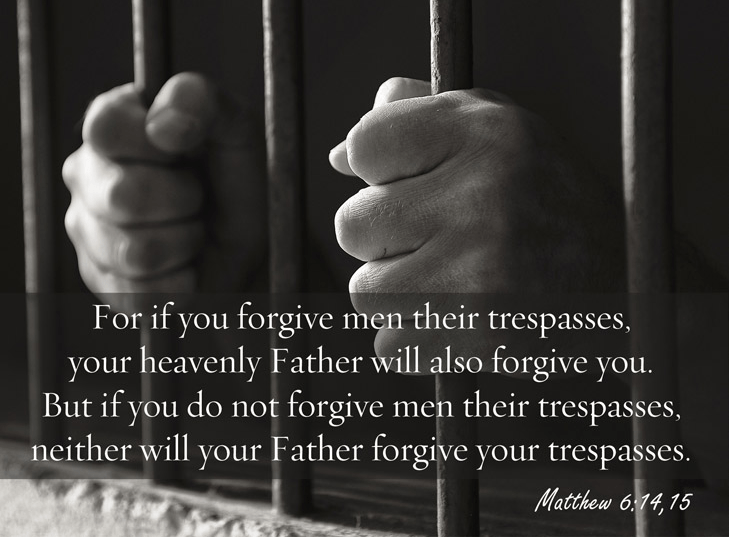
We all owe God a tremendous moral debt that we cannot pay back but must pay back (see Is 64:6, Rom 3:19, 23, 5:18). It is only through trusting in the finished work of Jesus that our debt can be paid (see Col 2:13-14). If we have experienced God’s forgiveness of God, it should not be difficult for the forgiven to forgive others and do whatever we can to bring about complete reconciliation. The great point is if that is not true about us, then we cannot presume that we have received the forgiveness of God ourselves (6:14-15).
The Reformation Study Bible is helpful here, “The point of this parable is not that God’s forgiveness, once granted, will be revoked if a follower of Jesus refuses to forgive his brother or sister. Rather, refusal to forgive is symptomatic of a person who fails to grasp the impossible depth of his debt and the infinite magnitude of God’s mercy and therefore has no reason to presume that he has received God’s forgiveness in the first place.” (5).
Have you recognised yourself as helpless and yet forgiven through Jesus? God’s forgiveness is stunning and glorious, and it should produce in us awe and thankfulness, which leads us to forgive others. Mark E. Ross observes, “What the parable is saying is that those who are forgiven will forgive, and thus that those who do not forgive are those who have not been forgiven. Saving and forgiving grace is transforming grace, and those who receive it from God must and can also give it to others. Those who do show it are those who know it, who have experienced that work of forgiveness in their own hearts. Thus those who are unforgiving can expect to meet an unforgiving King at the last day.” (6).
The parable forces us to ask some searching questions. Am I a person who practices forgiving others? Does God’s forgiveness flow from my heart toward others? Have I understood the great debt God has forgiven me?
In what scene of the parable do you see yourself in?
Notes
- For a brief explanation of parables see – https://theedgedoctor.wordpress.com/2021/07/17/lessons-from-the-parables-a-condition-of-entry/
- Gerald M. Bilkes – The Parable of the Unforgiving Servant, TableTalk Magazine, Ligonier Ministries, February, 2020, p11
- Simon J. Kistemaker – The Parables, Understanding the Stories Jesus Told, Baker Books, 2005, p66
- James Montgomery Boice – The Parables of Jesus, Moody Publishers, 1983, p214
- Theological Note – Matthew 18:35, The Reformation Study Bible ESV, Reformation Trust Publishing, 2015, p8520
- Mark E. Ross – Let’s Study Matthew, Banner of Truth Trust, 2014, p180
All scripture quotations are from the ESV

 seekingthekingdom.blog