A Common Struggle
Coronavirus is not the only pandemic we are facing at the moment. There is a pandemic of worry.
Over the past year, it seems as if the very foundations of life have been on the verge of breaking down. Our lives have been changed in various ways and degrees, and there may be legitimate reasons or concerns that have caused worry. Perhaps Coronavirus has come too close for comfort.
Worry and anxiety seem to be peculiar temptations to humanity. Perhaps you know people who appear to be thoroughly weighed down by worry. Worry has enslaved them. Worry is a genuine problem, yet it doesn’t solve anything or make much sense (6:27).
Jesus is concerned that His people not be enslaved to worry; so much so that in Matthew 6, He says do not worry three times (6:25,31,34). The word translated worry or anxious means to be ‘divided, separated or distracted’. This was the contrast between Martha and Mary (see Luke 10:38-42).
Adjusting our focus
Like Martha, worry serves to distract us from what is essential; it takes our eyes away from God and onto the problem. M.L. Jones writes,
“We cannot do better therefore then to say that it is not a ‘single eye’. There is a kind of double vision, a looking in two directions at once and the same time, and therefore not really seeing anything.” (1)
Matthew 6 is designed to act as an antidote to worry by pointing us to consider the attributes of God. In other words, the antidote to worry must be found in a proper understanding of God, a correct theology. It’s no help just to be told not to worry. What is required is a worldview by which you can deal with the problem of worry. Jesus, in this passage, points us to consider two great doctrines: the Sovereignty and the Providence of God. These great doctrines help us to adjust our focus away from the problem and onto God.
The God who rules
“God from all eternity did, by the most wise and holy counsel of his own free will, freely and unchangeably ordain whatsoever comes to pass: yet so, as thereby neither is God the author of sin nor is violence offered to the will of the creatures, nor is the liberty or contingency of second causes taken away, but rather established.”
The Westminster Confession of Faith Chapter 3
When we affirm that God ordains whatever comes to pass, we refer to His absolute rule and authority over all creation. God is a king without equal who works out his purposes down through history, through the lives of men and women, small and significant, and includes the tiniest intricacies of our lives, without infringing on our free will (see Prov 19:21). Yes, a mystery but put quite simply; if this great doctrine is not true about God, then God ceases to be God. As R.C. Sproul writes,
“If there is but one maverick molecule in the universe – one molecule running loose outside the scope of God’s sovereign ordination – we cannot have the slightest confidence that any promise God has ever made about the future will come to pass.” (2)
Little Faith
One of the significant causes of discouragement and difficulty in the Christian life is a failure to understand and grasp this great doctrine of God’s sovereignty. To some extent, Christians today have lost this doctrine. The inevitable result of this doctrinal loss is worry.
Worry is linked to a lack of faith (6:30). Jesus doesn’t accuse his listeners of not having faith; he accuses them of having little faith or inadequate faith. Worry is a result of a failure to think things through, a failure to understand and grasp the fact that God is the sovereign ruler over all the affairs of our lives.
Many Christians today have abandoned thinking and knowledge in favour of experiences. Still, if we are transformed by renewing our minds (see Rom 12:2), Christians, above all people, must be thinking people, for it is by exercising our minds in studying God’s word that we grow in knowledge, wisdom, and grace. This will lead us to more profound experiences with God and bring us to maturity.
Joining up the Dots
What dost thou mean by the providence of God? The Almighty and everywhere present power of God; whereby, as it were by His Hand, He upholds and governs heaven, earth, and all creatures; so that herbs and grass, rain and drought, fruitful and barren years, meat and drink, health and sickness, riches and poverty, yea, and all things come, not by chance, but by His fatherly hand.
What advantage is it to us to know that God has created, and by His providence doth still uphold all things? That we may be patient in adversity; thankful in prosperity; and that in all things, which may hereafter befall us, we place our firm trust in our faithful God and Father, that nothing shall separate us from His love; since all creatures are so in His hand, that without His will they cannot so much as move.
The Heidelberg Catechism Question 27 & 28
Whilst the sovereignty of God refers to His absolute rule, the providence of God refers to God’s continuing care, provision and supervision of the world. Providence is God’s sovereignty in action. The word providence means “to see beforehand.” However, the doctrine of providence not only refers to God’s ability to know the future. It refers to the working out of God’s sovereign rule in history. The Bible introduces us to this concept in Genesis 22, where Abraham calls God by Jehovah Jireh, “The Lord will provide.”
This does not mean we always understand God’s dealings with our world and lives. Providence is often a mystery to us. In the book of Genesis, we learn about Joseph, frequently used as a case study in the doctrine of providence.
“You intended to harm me, but God intended it for good to accomplish what is now being done, the saving of many lives.”
Genesis 50:20 NIV
How could Joseph come to such a conclusion? Only by looking back over his life could he understand how certain events had conspired to take him from an enslaved person to the Prime Minister of Egypt! The same is often true of the work of providence in our lives. Even though we may not always understand God’s Providence, we can be sure that for the Christian, God’s dealings with us are always for our eternal good (see Rom 8:31-39).
Our Heavenly Father
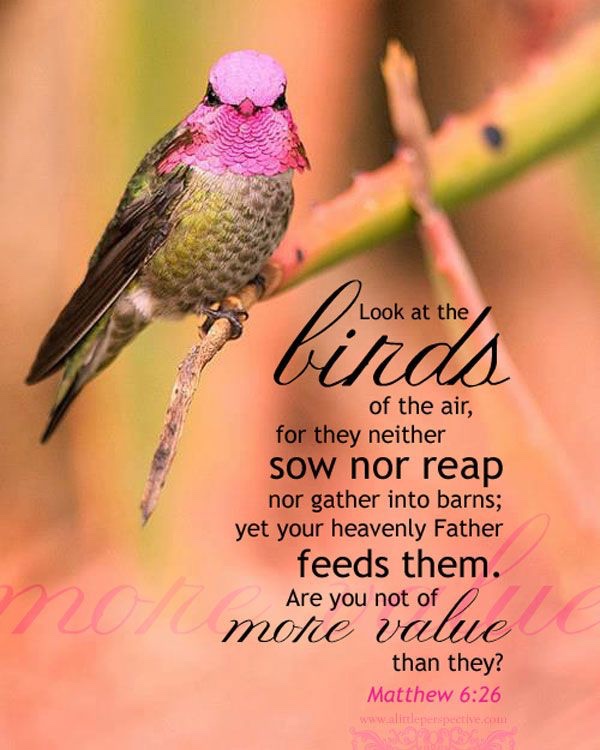
In Matthew 6, Jesus refers to God as your ‘Father’ or ‘heavenly Father’ several times. This is key; if we know God as Father, we can deal with the worry. Why? Because we should come to the logical conclusion that a God who is a loving Father will only do what is good for His children. This is practical theology. We are to enjoy all the benefits of a real relationship as a child of God. Why should we be worried when the God who rules everything has become ‘our Father?’ To drive this home, Jesus asks us to consider the birds of the air (6.26). It is said of Martin Luther that when he walked into the woods, he used to raise his hat to the birds and say,
“Good morning theologians – you wake and sing, but I, old fool, know less than you and worry over everything, instead of simply trusting in the heavenly Fathers care.”
When Jesus says that birds neither sow nor reap nor gather into barns, he is not saying that birds are lazy. On the contrary, birds are very industrious. They leave their nests early to collect insects and worms. They migrate from one part of the world to the other. They make homes for themselves and take care of their young.
Jesus is pointing out that although birds make no provision for themselves (unlike us), God provides for them. He sees that the birds have food and don’t worry about it. They are not anxious about life; they do not store up. They are not like the rich fool who was guilty of trusting in his riches and not God (see Luke 12:16-21). They know that the earth will yield food as they leave their nests. Perhaps in the Providence of God, they will even come across people with bags of bread! Jesus is saying to us – look at what is in front of your eyes and learn from it!
Not only does God provide for birds, but he also sees their deaths (10:29-31). The application is profound. If birds, which we see as insignificant creatures (apologies to bird lovers!) exist within God’s sovereign care. If the God who sustains the universe cares about the death of a bird – how could we ever doubt his love and care towards us? As Jesus goes on to say, even the hairs of our head are all numbered (10:30).
Secondly, Jesus asks us to consider the flowers of the field (6:28-30), and perhaps this is even more profound. Consider the staggering beauty of flowers. Their intricacies, their types and colours. If God so lavishly provides for a flower that may never be seen but is here today and gone tomorrow, how could we ever doubt His provision for eternal beings? It’s powerful logic. Jesus uses a powerful argument from the lessor to the greater or the more significant to the lessor, depending on its order. If A is true, how much more is B true?
Worldliness and worry
Matthew 6 forms part of the Sermon on the Mount. Addressing His disciples, Jesus teaches what living out the Christian life in a fallen world means. The demands placed on us in the Sermon on the Mount set the moral bar so high that we might recognise that we, being sinful, cannot attain it and so drive us to God for grace, mercy and forgiveness. Therefore, the Sermon on the Mount is not a list of dos and don’ts. It describes the character of a person who has a relationship with Jesus Christ as Lord and Saviour. Sinclair B. Ferguson says,
“This teaching will change us only when we submit to the sovereign and gracious reign of the one who preaches it, for the Sermon on the Mount enshrines in its teaching the authority and lordship of Jesus himself.” (3)
In the broader context of Matthew 6, Jesus links worry with what Christians call ‘worldliness’. Jesus wants us to understand that if our treasures are only to be found in this life, then the inevitable outcome will be worry (6:19-24). Jesus warns his disciples against worldliness, but for those who are not Christians, worldliness is all they know (see Rom 8:5-8).
We will never know freedom from the worry this world brings until we are free from worldliness, and we will never be free from worldliness until we submit to Jesus’ reign. Worldliness is a tragic symptom of not knowing God as our Heavenly Father.
If you want to know if you are ‘worldly, ‘ you can take a simple test. Consider your life, desires, goals, aspirations, and the most important things to you. If you follow those things, they will lead you to a throne. Who is on that throne? Is it Jesus, or is it? By nature, it is self (see Eph 2:1-3). This is why Jesus tells his disciples to seek God’s Kingdom and righteousness first (6:33). We must do likewise.
The God who gave
Paul uses the same powerful argument as Jesus in the Epistle to the Romans. This time, it’s from the greater to the lesser (see Rom 8:31-32). If our heavenly Father has gone to extreme lengths to deliver us from condemnation by not sparing His Son, how could we doubt His providential care?
To seek the Kingdom of God, we must go via the cross. Jesus’s death was not a random event. It was handed over by God’s deliberate plan and foreknowledge (see Acts 2:22-23). The cross shows God’s ultimate, mysterious, but kind providence. By the cross, we are reconciled to God and receive the forgiveness of sins; by the cross, we can draw near to God and deal with the problem of worry (see Phil 4:4-7).
The antidote to worry is to know Jesus.
Do you know Him yet?
Notes
- D. Martyn Lloyd-Jones – Studies in the Sermon on the Mount, IVP, 2002, p426
- R.C. Sproul – Does God control everything? Reformation Trust Publishing, 2012, p42-43
- Sinclair B Ferguson – The Sermon on the Mount, Kingdom Life in a Fallen World, Banner of Truth, 1987, p5

 seekingthekingdom.blog